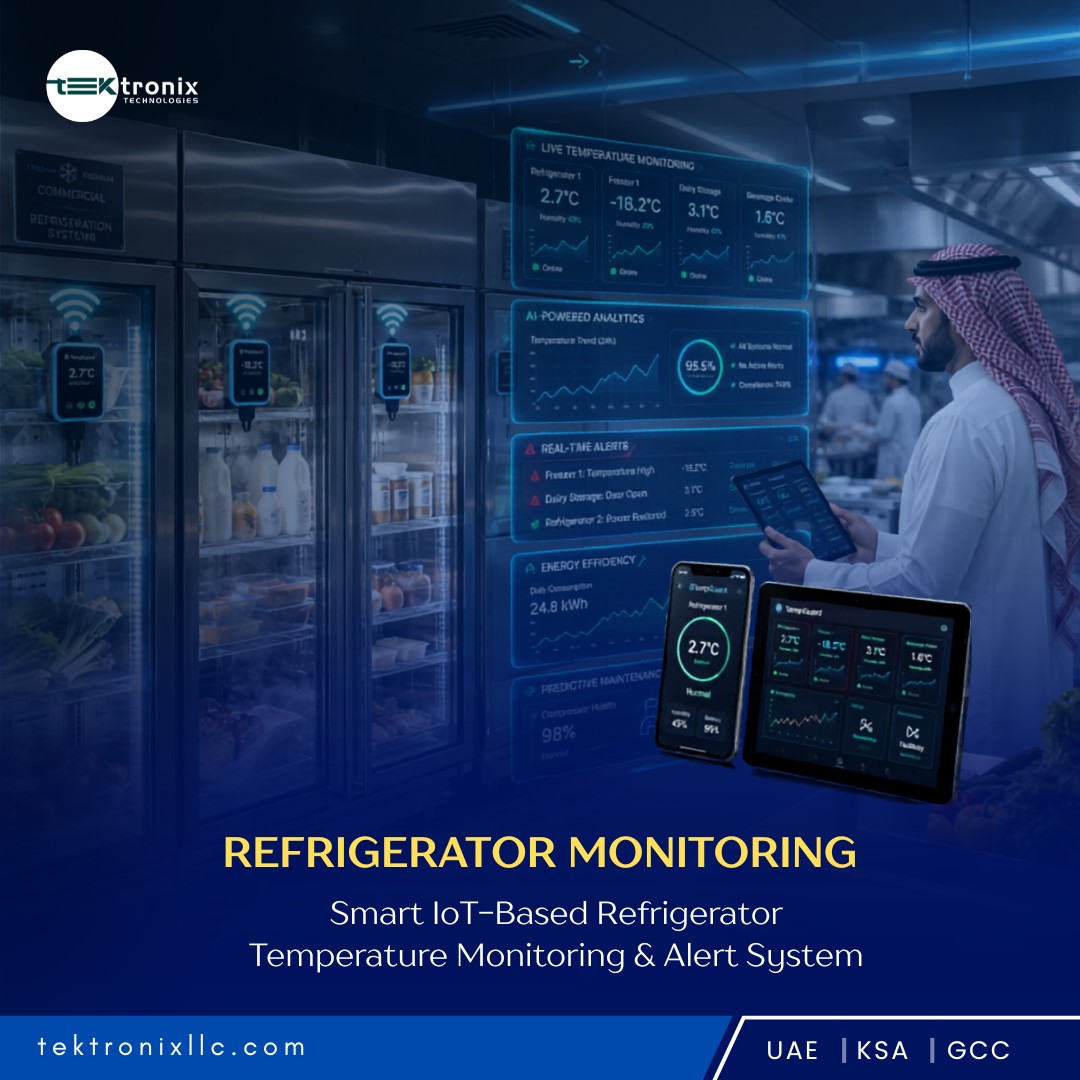
In a region where extreme ambient temperatures make cold-chain integrity a daily operational challenge, continuous and intelligent cold-storage monitoring is not an optional enhancement — it is an essential safeguard for product quality, patient safety, regulatory compliance, and financial protection. By combining precision sensing, wireless connectivity, cloud-based remote visibility, tamper-evident data logging, and automated multi-tier alerting, Tektronix LLC delivers a cold-chain monitoring ecosystem that gives GCC healthcare, pharmaceutical, food, and laboratory operators the confidence that every asset in their network is performing within specification — at all times, without exception. Whether your requirement spans a single hospital pharmacy in Riyadh or a national pharmaceutical distribution network serving all six GCC states, Tektronix's two-decade regional pedigree, regulatory expertise, and certified engineering teams ensure your cold chain is protected, compliant, and audit-ready.
FAQs
1. How does continuous Temperature Monitoring differ from manual temperature logging?
Temperature Monitoring with automated sensors records readings every 30 seconds to 5 minutes — 24 hours a day, 7 days a week — without human intervention, capturing every temperature excursion including those that occur overnight, during weekends, or between manual checks. Manual logging — typically twice daily — can miss excursions that begin and resolve within a few hours, leaving facilities with incomplete records and undetected product compromise. Automated monitoring also eliminates transcription errors and the risk of falsified records, generating cryptographically verified data that satisfies SFDA, MoHAP, and GDP auditor requirements with far greater reliability than paper-based systems.
2. What communication protocols do Smart Sensors support for connectivity in GCC facilities?
Smart Sensors deployed by Tektronix support multiple wireless communication protocols, selected based on facility infrastructure and coverage requirements: Wi-Fi for facilities with existing enterprise wireless networks, ZigBee mesh for high-density multi-asset deployments such as hospital pharmacy stores, LoRaWAN for large-area or multi-building campuses where Wi-Fi coverage is incomplete, and NB-IoT (Narrowband IoT) using the STC, Mobily, or Zain KSA mobile networks for remote facilities without local wireless infrastructure. All protocols use AES-128 or AES-256 encrypted data transmission, and sensors buffer readings locally during connectivity interruptions to prevent data gaps in compliance records.
3. Can Remote Temperature Monitoring platforms generate SFDA-compliant excursion reports automatically?
Remote Temperature Monitoring platforms deployed by Tektronix generate SFDA-compliant excursion reports automatically upon threshold breach — capturing the exact time of excursion onset, duration, peak deviation, responsible asset ID, and Mean Kinetic Temperature (MKT) impact calculation. Reports are digitally signed, timestamped, and stored in an immutable audit log. Scheduled compliance reports — daily, weekly, or monthly — are emailed automatically to quality managers and regulatory officers. For SFDA licence renewal submissions, the platform exports a complete 12-month temperature history in the format specified by SFDA's Good Storage and Distribution Practices (GSDP) guidelines, eliminating manual data compilation entirely.
4. How do Wireless Temperature Monitoring deployments handle facilities without reliable internet connectivity?
Wireless Temperature Monitoring systems from Tektronix are designed with offline resilience as a core architectural principle. Each smart sensor stores up to 90 days of readings in onboard flash memory, ensuring no data is lost during extended connectivity outages. Local gateway devices — deployed at each facility — provide a secondary buffering layer, storing data and generating local alerts via SMS modem even when cloud connectivity is unavailable. When connectivity is restored, all buffered data synchronises automatically to the cloud platform in chronological order, preserving a complete, gap-free record. For facilities in remote KSA and Oman locations, NB-IoT connectivity via national mobile networks provides a reliable fallback independent of local Wi-Fi infrastructure.
Contact Us:
00971 58 8899612