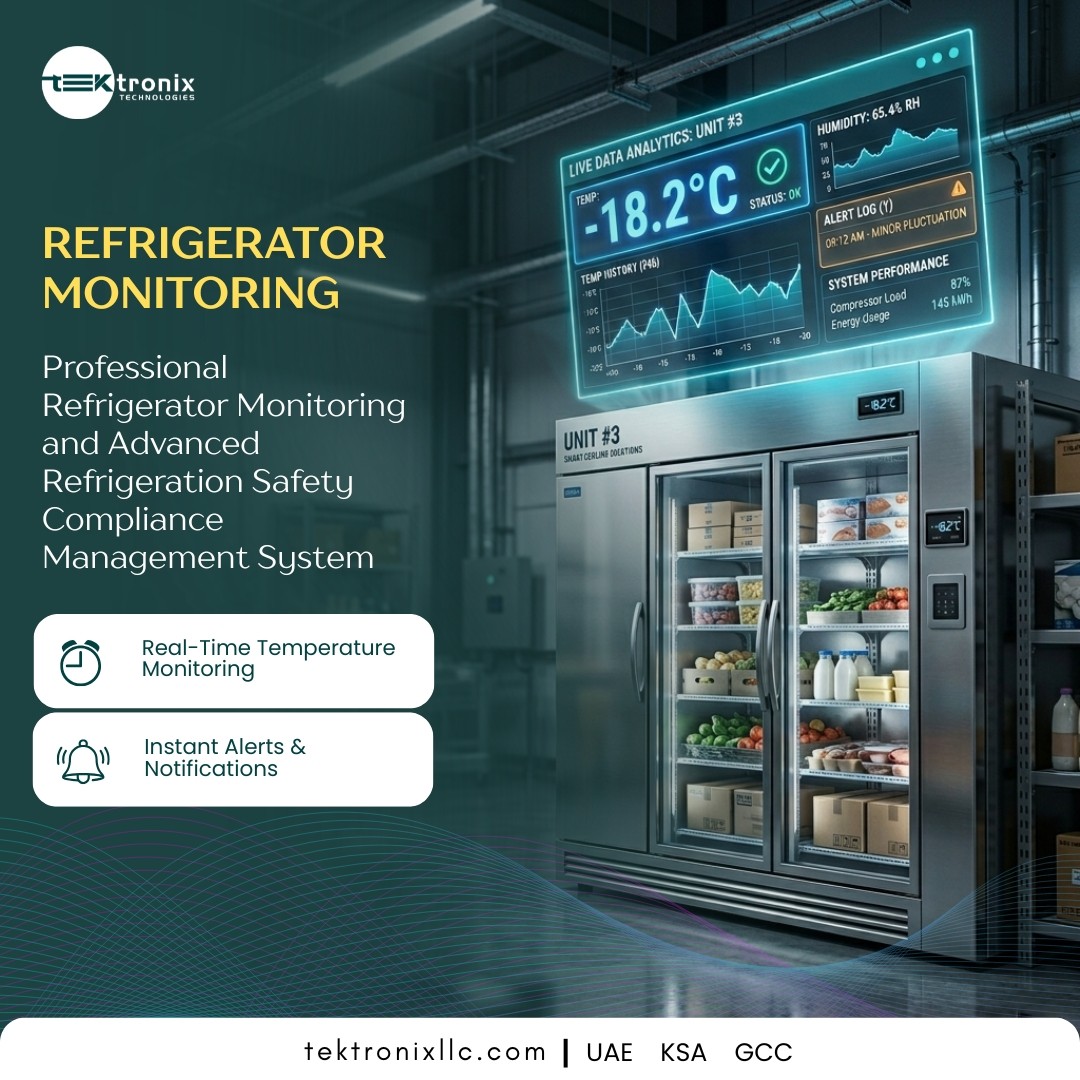
Food safety, pharmaceutical integrity, and regulatory compliance across Kuwait and the GCC depend on one foundational capability: knowing, at every moment, that every temperature-sensitive asset in your facility is operating within its required range. Refrigerator Monitoring by Tektronix LLC and Expedite IoT delivers that capability through a layered technology stack — calibrated Smart Sensors, portable Temperature Data Loggers, infrastructure-free Wireless Temperature Monitoring, cloud-powered Remote Temperature Monitoring, and real-time Temperature Alerts — all underpinned by deep regulatory expertise and a GCC-wide service infrastructure.
Whether your requirement is for Refrigerator Monitoring Kuwait-focused compliance documentation for PAFN and MoH audits, or a unified Refrigerator Monitoring GCC-wide platform serving operations across multiple member states, Tektronix LLC has the engineering capability, regulatory knowledge, and operational track record to deliver a solution that protects your products, your patients, and your regulatory standing. Contact us today to schedule a cold-chain assessment for your facility.
FAQs
1. What regulatory standards govern Refrigerator Monitoring in Kuwait?
In Kuwait, refrigerator and cold-chain monitoring is governed by the Public Authority for Food and Nutrition (PAFN) for food storage and processing facilities, and by the Kuwait Ministry of Health (MoH) for pharmaceutical cold-chain applications. PAFN's HACCP framework requires continuous temperature logging at all critical control points in food storage and production processes, with records retained for a minimum of two years and available for inspection on demand. The Kuwait MoH's pharmaceutical cold-chain guidelines align with WHO Good Storage and Distribution Practice standards, mandating calibrated sensor systems, documented alarm response procedures, annual qualification studies for cold rooms, and traceable calibration certificates for all temperature measurement equipment. Tektronix LLC's monitoring platform is designed to generate the specific documentation formats that both PAFN and Kuwait MoH inspectors request during facility audits.
2. How do Smart Sensors differ from standard thermometers in cold-chain applications?
Standard thermometers provide a point-in-time reading that requires a human operator to be physically present to observe and record it. Smart Sensors, by contrast, measure temperature continuously — typically every 30 to 60 seconds — and transmit each reading automatically to a centralised cloud monitoring platform without any human intervention. This continuous, automated measurement capability eliminates the time-gap vulnerability of manual monitoring, where a temperature excursion occurring between manual check rounds can go undetected for hours. Smart sensors also maintain a tamper-evident digital record of every reading, providing the complete historical temperature log that regulatory authorities require, whereas manual log books are vulnerable to transcription errors and, in high-pressure environments, to deliberate falsification. Tektronix LLC specifies smart sensors calibrated to ±0.2°C accuracy or better, meeting the EN 12830 and WHO PQS calibration standards applicable to pharmaceutical and food safety cold-chain monitoring.
3. What is the advantage of Wireless Temperature Monitoring over wired sensor systems?
Wireless Temperature Monitoring eliminates the need for physical cabling between sensors and the monitoring gateway, which delivers several practical advantages in GCC facilities. Installation is significantly faster and less disruptive — wireless sensors can be deployed in a cold room or refrigerator in minutes, without drilling penetrations through insulated walls or running cable trays through operational food preparation areas. Long-term maintenance costs are lower, as there are no cables to be damaged by heavy goods movement, pest activity, or facility refurbishment. In retrofit applications — such as adding monitoring to an existing pharmaceutical warehouse or restaurant cold room — wireless systems avoid the structural disruption that wired installations would require. Tektronix LLC selects the optimal wireless protocol for each deployment based on facility geometry, wall construction, interference environment, and network availability, ensuring reliable transmission without signal dropouts that could create gaps in the compliance record.
4. How quickly do Temperature Alerts reach responsible staff when an excursion occurs?
Tektronix LLC's monitoring platform is configured to generate and dispatch Temperature Alerts within 60 seconds of a threshold breach being detected by the sensor — a response latency that is constrained by the sensor's transmission interval rather than any processing delay in the platform itself. Alerts are delivered simultaneously via SMS, email, and mobile push notification to all personnel configured in the alarm recipient list for the affected asset, ensuring that the responsible staff member receives the alert regardless of which communication channel they are actively monitoring at the time. Escalation rules configured by Tektronix LLC ensure that if the primary alert is not acknowledged within a defined window — typically 15 to 30 minutes, customised to the client's operational context — a secondary alert is automatically dispatched to a supervisor or manager. All alert events and acknowledgements are time-stamped and logged in the platform's audit trail, creating the excursion documentation that WHO GDP guidelines and GCC MoH pharmaceutical standards require.
5. Can Temperature Data Loggers be used for in-transit pharmaceutical shipments across the GCC?
Yes. Temperature Data Loggers are specifically designed for in-transit cold-chain monitoring applications where a networked sensor system is impractical — including pharmaceutical shipments in courier cold boxes, refrigerated truck deliveries between GCC distribution centres, and air freight consignments of temperature-sensitive biologics or vaccines. Tektronix LLC supplies multi-trip USB and Bluetooth data loggers with configurable sampling intervals as short as one minute, PDF and CSV report generation for regulatory submission, and alarm indicator flags that provide instant visual confirmation of whether a shipment remained within its required temperature range throughout transit. For pharmaceutical importers operating under Kuwait MoH GDP licensing and SFDA import controls in Saudi Arabia, these logger-generated transit reports satisfy the cold-chain documentation requirements that accompany each imported consignment through customs clearance and final delivery acceptance.
Contact Us:
00971 58 8899612